
Teegarden’s Star c
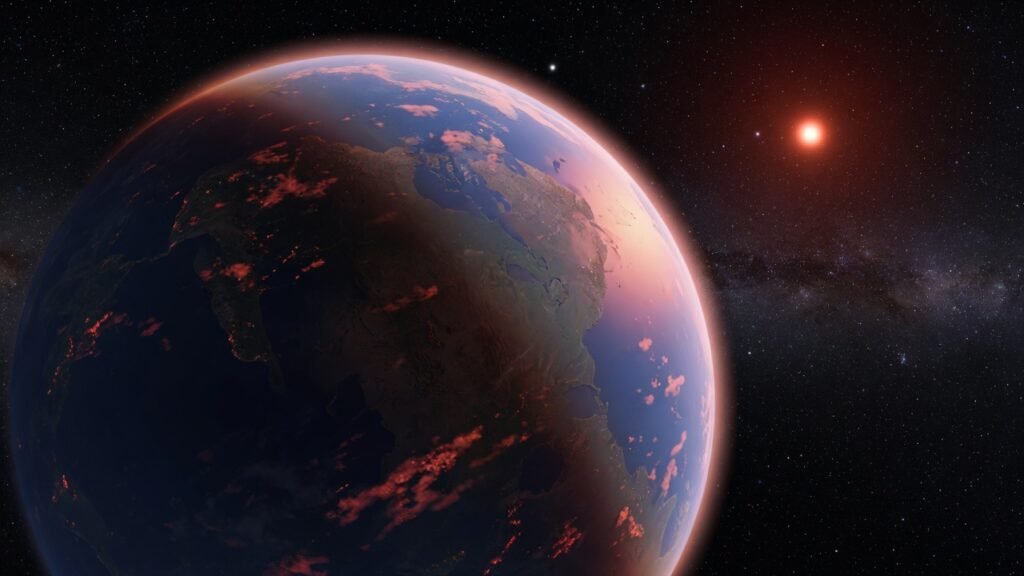
Teegarden’s Star c shares the same quiet red dwarf M-type host as its sibling, only 12 light-years from Earth. Measuring 1.0 × Earth in radius, it orbits every 11.4 days at 0.044 AU, residing in the outer habitable zone. The system’s proximity and the star’s stability make it ideal for future atmospheric probes. This Earth-analog […]
TOI-2094 b
TOI-2094 b is a super-Earth exoplanet orbiting a quiet red dwarf M-type star 163 light-years from Earth. Nearly twice our planet’s size with a mass of 4.27 Earth masses, it completes its orbit every 18.8 days at 0.136 AU, positioning it on the outer edge of the habitable zone. Its equilibrium temperature hovers around a […]
TOI-4616 b
TOI-4616 b transits a nearby mid-M4 red dwarf 92 light-years from Earth, with a radius of 1.2 × Earth. It orbits every 1.55 days at a tight distance, receiving high stellar flux far outside the habitable zone. Its benchmark properties make it valuable for studying rocky planets around cool dwarfs. This steadfast world in the […]
TOI-2267 c
TOI-2267 c shares the compact M-dwarf binary with its sibling, sized 1.1 × Earth and orbiting every 3.5 days at 0.0263 AU. As part of this tight configuration, it navigates complex dynamics while maintaining a rocky profile. The system’s proximity and transiting nature make it a benchmark for binary-hosted planets. It stands eternally in the […]
TOI-2267 b
TOI-2267 b transits one component of a compact M-dwarf binary 72 light-years away, with a radius of 1.0 × Earth. Orbiting every 2.3 days at 0.0205 AU, it endures warm conditions far from the habitable zone. In this rare close-binary setup (8 AU separation), it offers clues to planet formation amid gravitational chaos. This compact […]
GJ 887 d
GJ 887 d orbits a bright, tranquil red dwarf M-type star just 11 light-years from Earth, one of the nearest systems to our own. As a super-Earth with a minimum mass exceeding 6 Earth masses, it completes an orbit every 50.8 days at 0.212 AU, residing in the habitable zone where surface temperatures could allow […]
LHS 1903 e
LHS 1903 e orbits a red dwarf M-type star 116 light-years distant, a super-Earth with 1.7 × Earth radius and 5.8 Earth masses, revealing high density and gas-poor composition. Orbiting every 29.3 days at 0.15 AU, it sits near the habitable zone’s outer edge despite its system’s unusual architecture—rocky outermost after inner gas-rich worlds. This […]
Barnard b
Barnard b circles Barnard’s Star, one of the closest at 6 light-years, with an estimated radius around 0.9 × Earth. Its tight 3.2-day orbit lies well inside the habitable zone, resulting in high temperatures. As a sub-Earth in our cosmic backyard, it highlights rocky planet diversity around fast-moving dwarfs. This entry endures in the Galactic […]
K2-18 b
K2-18 b orbits a cool red dwarf M-type star 124 light-years from Earth, measuring 2.4 × Earth in radius with a mass of 8.9 Earth masses. It completes its orbit every 32.9 days at 0.14 AU, comfortably within the habitable zone. Atmospheric studies reveal water vapor, methane, and possible biosignature hints. As a potential ocean […]
Ross 128 b
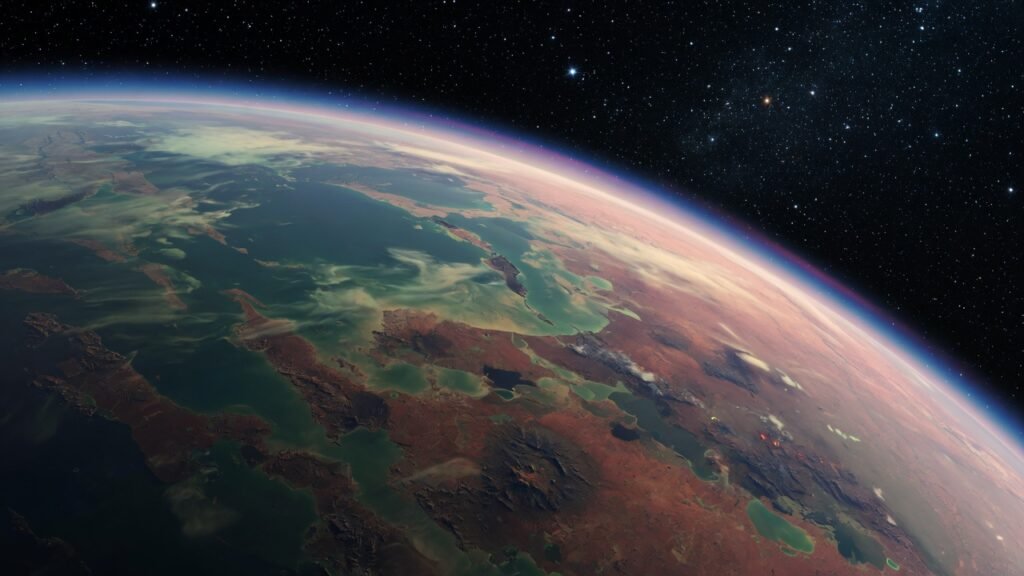
Ross 128 b circles a serene red dwarf M-type star just 11 light-years distant, with a radius of 1.4 × Earth and mass suggesting rocky composition. It orbits every 9.9 days at 0.049 AU, within the habitable zone where liquid water could persist. The host’s unusually low flare activity enhances atmospheric retention prospects compared to […]