
Kepler-62 f
Kepler-62 f circles an orange dwarf K-type star 1200 light-years distant, with a radius of 1.4 × Earth. It completes an orbit every 267 days at 0.72 AU, residing in the habitable zone for liquid water possibilities. As part of a five-planet system, its rocky nature and temperate conditions make it a benchmark for Earth-like […]
TOI-2431 b
TOI-2431 b orbits a nearby K-type dwarf 117 light-years away, an Earth-sized world with 1.5 × Earth radius and 6.2 Earth masses, yielding high density consistent with iron-rich composition. Its extreme 5.4-hour orbit at 0.0063 AU subjects it to intense irradiation and tidal forces, resulting in equilibrium temperatures around 2063 K and likely molten surfaces. […]
GJ 367 b
GJ 367 b transits a nearby red dwarf M-type star 31 light-years away, with a radius of 0.9 × Earth and high density suggesting an iron core. It orbits every 0.32 days at a scorching close distance, far inside the habitable zone. As an ultra-short-period sub-Earth, it reveals extreme planetary stripping processes. This compact beacon […]
55 Cancri e
55 Cancri e orbits a Sun-like K-type star 41 light-years away, with a radius of 1.9 × Earth. Its ultra-short 18-hour orbit creates extreme temperatures, potentially forming molten surfaces. As a classic hot super-Earth, it contrasts temperate worlds and reveals volcanic geology. It remains a dramatic fixture in the Galactic Codex, illustrating the fiery extremes […]
K2-229 b
K2-229 b orbits a Sun-like G-type star 335 light-years distant, measuring 1.2 × Earth in radius with exceptional density hinting at iron dominance. Its ultra-short 0.86-day orbit exposes it to intense heat, stripping potential atmospheres. As a Mercury analog but denser, it provides clues to core-exposed worlds. It endures in the Galactic Codex as a […]
Kepler-10 b
Kepler-10 b circles a Sun-like G-type star 608 light-years away, with a radius of 1.5 × Earth and rocky composition. Orbiting every 0.84 days, it faces extreme temperatures far from the habitable zone. As the inaugural confirmed rocky exoplanet, it marks a pivotal discovery in planetary science. This fiery world stands eternally in the Galactic […]
TRAPPIST-1 e
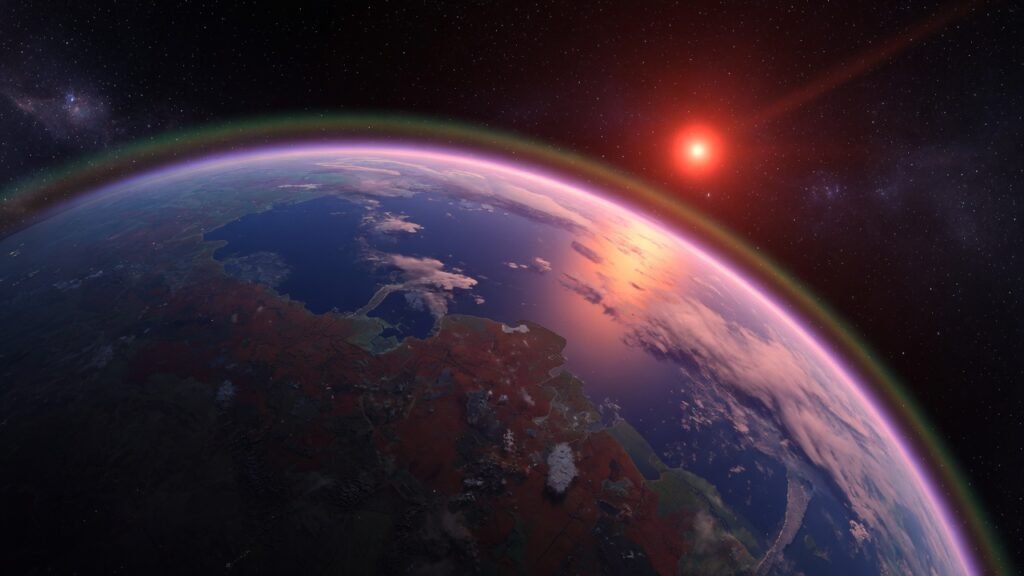
TRAPPIST-1 e is one of seven roughly Earth-sized planets orbiting an ultra-cool red dwarf M-type star 40 light-years from Earth. With a radius of 0.9 × Earth, it completes an orbit every 6.1 days at 0.029 AU in the habitable zone’s heart. Resonant orbits and low stellar flux support potential rocky surfaces with atmospheres and […]
Teegarden’s Star b
Teegarden’s Star b orbits one of the closest stars to Earth, a faint red dwarf M-type 12 light-years away. With a radius of 1.1 × Earth, it completes its orbit every 4.9 days at 0.025 AU, placing it firmly in the habitable zone. Its host star’s low activity minimizes atmospheric erosion risks, favoring potential surface […]
LHS 1140 b
LHS 1140 b circles a nearby red dwarf M-type star 49 light-years from Earth, with a radius of 1.7 × Earth and mass suggesting high density and possible volatiles. It orbits every 24.7 days at 0.095 AU within the habitable zone. Recent studies point to a possible ocean world composition. As one of the best-characterized […]
TOI-700 d
TOI-700 d is an Earth-sized rocky exoplanet revolving around a stable red dwarf M-type star 101 light-years distant. With a radius of 1.1 × Earth, it orbits every 37.4 days at 0.16 AU in the conservative habitable zone. Low stellar flare activity enhances habitability prospects compared with many M-dwarf systems. Its terrestrial composition and temperate […]