
Sub-Neptunes
Bigger than Earth, smaller than Neptune
Sub-Neptunes are the most common size of planet we keep finding, and the hardest to picture. They are larger than a rocky super-Earth and smaller than Neptune, usually wrapped in a thick envelope of hydrogen, water, or haze. Some may hide a rocky core. Others may be water worlds under a steamy sky. Telescopes can measure the size. The inside is still a guess.
That in-between size is why they matter. They are the bridge from rocky worlds to ice giants, and the galaxy seems to make a lot of them. A few, like K2-18 b and GJ 1214 b, are close enough that JWST can actually sniff the air.
- About 1.7–4 times Earth’s radius — bigger than rock, smaller than Neptune
- Thick atmospheres that can hide the surface completely
- Some may be water worlds; others are rocky cores with a gassy blanket
- Haze is common, which makes them look featureless to telescopes
- The most common planet size in the Kepler census
- Prime targets for atmosphere studies
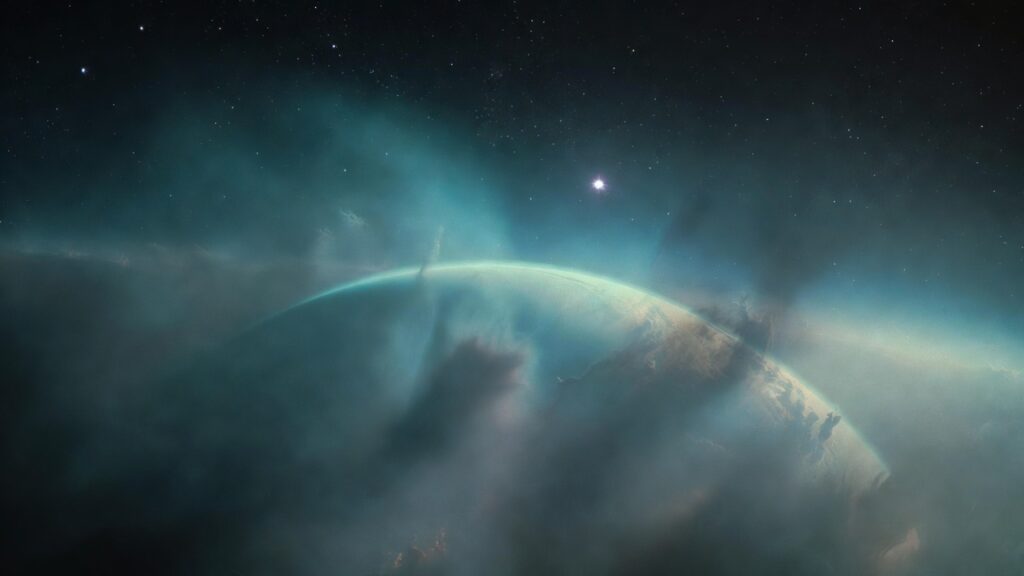
Sub-Neptune Codex
Size:
2.0 × Earth
Distance from Earth:
73 light-years
Habitable Zone:
No
Star Type:
M-type
Fun Fact:
JWST found methane, carbon dioxide, and water in this world’s sky, with heavy molecules making up about half of its atmosphere!
Size:
2.7 × Earth
Distance from Earth:
48 light-years
Habitable Zone:
No
Star Type:
M-type
Fun Fact:
This nearby mini-Neptune wears a thick hazy sky that hid its atmosphere from telescopes for years!
Size:
3.2 × Earth
Distance from Earth:
115 light-years
Habitable Zone:
No
Star Type:
G-type
Fun Fact:
This world orbits a bright Sun-like star that shines almost like our own, making it a close cousin in the cosmic family.
Size:
2.8 × Earth
Distance from Earth:
28 light-years
Habitable Zone:
Maybe
Star Type:
M-type
Fun Fact:
This world circles a cool red star so closely that a year there lasts only about as long as a month on Earth!
Size:
2.4 × Earth
Distance from Earth:
427 light-years
Habitable Zone:
No
Star Type:
G-type
Fun Fact:
This well-measured sub-Neptune offers a window into mysterious worlds between rocky planets and gas giants!
Size:
2.5 × Earth
Distance from Earth:
440 light-years
Habitable Zone:
No
Star Type:
K-type
Fun Fact:
A mysterious sub-Neptune sibling that hints at hidden depths beneath its gaseous layers in a busy star system.
Size:
2.3 × Earth
Distance from Earth:
337 light-years light-years
Habitable Zone:
Maybe
Star Type:
M-type
Fun Fact:
Nestled at the edge of possibility, TOI-1752 c could host intriguing conditions where oceans might linger under just the right starry glow.