
Ice Giants
Cold cores, hot orbits, comet tails
Ice giants are Neptune-class worlds: bigger than a sub-Neptune, smaller than Jupiter, built from ice, rock, and a thinner blanket of hydrogen and helium. In our Solar System that means Uranus and Neptune. Around other stars, some of them orbit so close the atmosphere streams off like a comet tail.
They are the step between puffy sub-Neptunes and true gas giants. A few are close and bright enough that Hubble and JWST have already seen water vapor and clear skies. The rest are still mostly a size and a mass — which is enough to know they are not rocky, and not Jupiter.
- Roughly 3.5–6 times Earth’s radius, near Neptune’s size
- Interiors of ice and rock, not a huge hydrogen ball
- Some are “hot Neptunes” scorched close to their stars
- Atmospheres can leak into space and leave a tail
- Clearer skies than many sub-Neptunes, so easier to study
- Our own Uranus and Neptune are the local examples
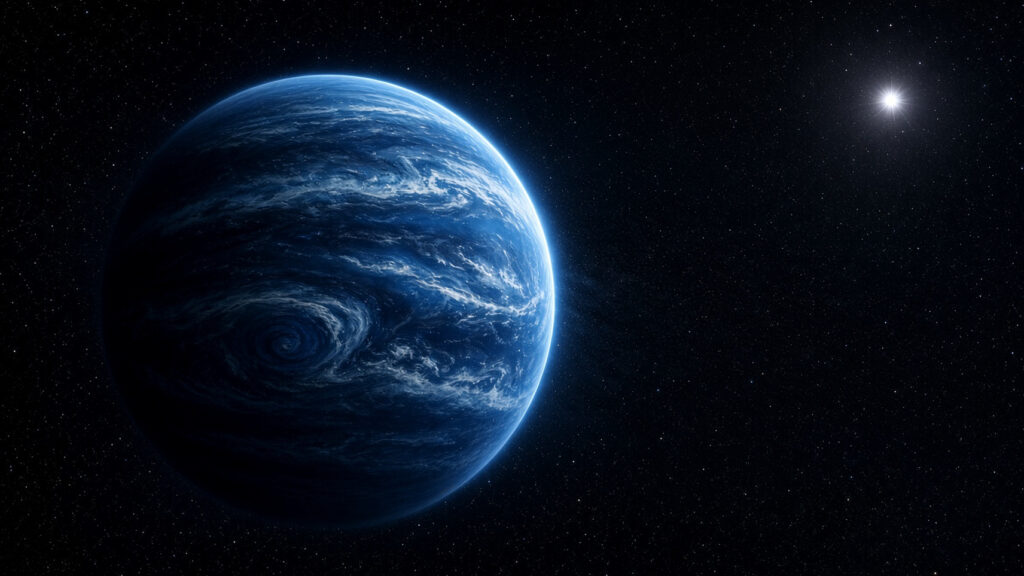
Ice Giant Codex
Size:
4.6 × Earth
Distance from Earth:
96 light-years
Habitable Zone:
No
Star Type:
M-type
Fun Fact:
Hubble caught this warm Neptune bleeding a huge cloud of hydrogen into space, and JWST later found sulfur dioxide in its skies!
Size:
4.7 × Earth
Distance from Earth:
262 light-years
Habitable Zone:
No
Star Type:
G-type
Fun Fact:
This scorching Neptune survives in the ‘Neptunian desert’ where worlds like it almost never last, and its gleaming clouds make it one of the most reflective planets known!
Size:
4.8 × Earth
Distance from Earth:
32 light-years
Habitable Zone:
No
Star Type:
M-type
Fun Fact:
This Neptune-size world orbits a young flare star still wrapped in a sparkling debris disk!
Size:
4.4 × Earth
Distance from Earth:
123 light-years
Habitable Zone:
No
Star Type:
K-type
Fun Fact:
Hubble found water vapor in this Neptune-sized world’s relatively clear sky!
Size:
4.2 × Earth
Distance from Earth:
32 light-years
Habitable Zone:
No
Star Type:
M-type
Fun Fact:
This ice giant is about Neptune’s size, yet it orbits so close that a huge hydrogen tail streams off like a comet!